Introduction
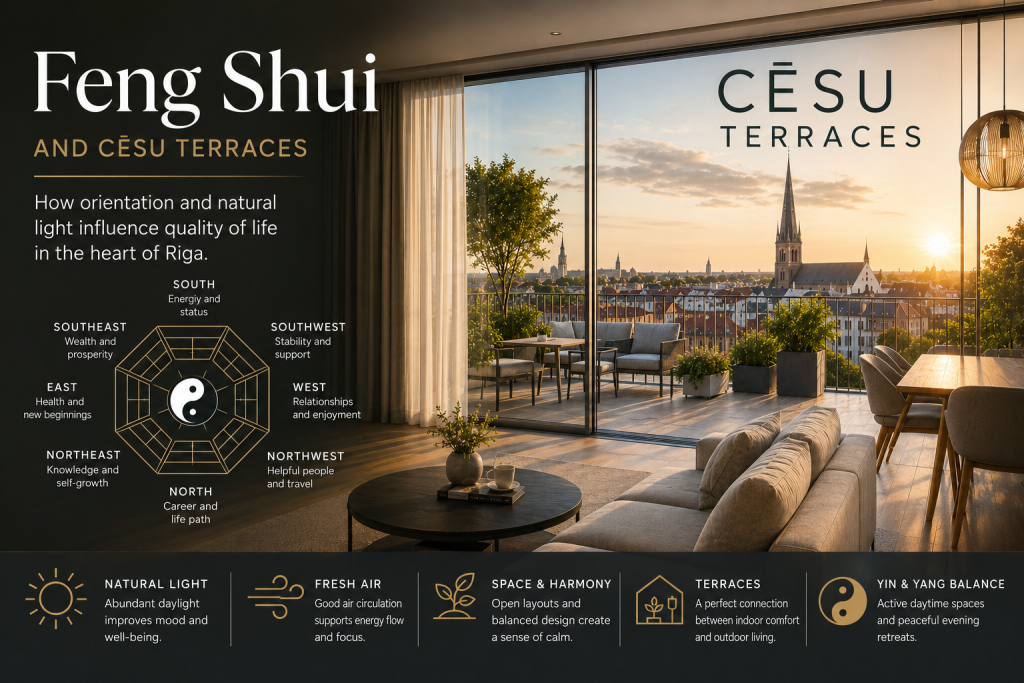
In Feng Shui philosophy, a home is not just a physical structure – it is an energy system in which light, air, and spatial layout influence everyday life.
In modern architecture, this principle can be clearly seen in projects such as Cēsu Terraces, where:
- each apartment has a balcony or terrace
- natural light reaches deep into the living spaces
- cardinal directions become a real factor in quality of life
☯️ Feng Shui principle in Cēsu Terraces
Feng Shui (风水) is based on the idea that Qi (气) – life energy – flows through space.
In a modern interpretation, this can be understood very simply:
Qi = natural daylight + airflow + openness toward the terrace
And in Cēsu Terraces, terraces are not decorative – they function as an essential extension of living energy.
🧭 Bagua directions and meaning
🌅 East – “New beginnings”
Morning sunlight directly in the kitchen or bedroom creates a natural start to the day without artificial lighting.
👉 Associated with health and daily routine.
☀️ South – “Energy and status”
Bright daylight fills the living areas, while the terrace becomes an active social space.
👉 Enhances Yang energy (activity and social life).
🌇 West – “Enjoyment of life”
Sunsets are visible directly from the balcony or terrace, creating warm evening atmospheres.
👉 Associated with relationships and relaxation.
🧘 North – “Stability and focus”
Even, calm light with less direct sun, ideal for work or concentration spaces.
👉 Supports career focus and stability.
🌿 Terraces as the energy core of Cēsu Terraces
From a Feng Shui perspective, terraces act as:
- a “breathing point” of Qi
- a transition between interior and exterior space
- an expansion of living energy beyond walls
👉 Practically this means:
- in summer, the terrace becomes an additional living room
- in winter, it brings light and visual openness
- year-round, it enhances the feeling of space
🧭 Yin–Yang balance in Cēsu Terraces
The project naturally reflects Yin–Yang balance:
- ☀️ Yang zones → south- and west-facing living areas and terraces
- 🌙 Yin zones → bedrooms and quieter north-facing spaces
👉 This creates a natural rhythm:
- daytime → light, activity, productivity
- evening → calm, relaxation, sunsets
🧠 Interesting architectural fact
Studies in real estate behavior show that apartments with strong daylight exposure and proper orientation are used significantly more during terrace season, and people tend to prefer evening sun exposure even when it is not the most rational choice.
👉 This is why orientation becomes a key factor in perceived living quality.
🌇 Conclusion
From a Feng Shui perspective, Cēsu Terraces is not just a modern residential project in central Riga, but an example of how:
light, orientation, and spatial flow shape everyday human experience.
And even without naming it Feng Shui, the principle remains the same:
the best homes are not only beautiful — they work in harmony with human life rhythms.